Problem
Given the number of vertices n and query information queries, write a solution function to process queries based on their types and return the results in order.
There are two types of queries:
- [-1, x, y] - Union Query:
Merge verticesxandyinto the same set. - [-2, x, y] - Find Query:
Returntrueif verticesxandybelong to the same set; otherwise, returnfalse.
x and y are distinct natural numbers between 1 and n.
Concept Explanation
The Union-Find Algorithm is a method to efficiently represent and manipulate disjoint sets. It supports the following operations:
- Union: Merge two disjoint sets into one.
- Find: Determine which set an element belongs to.
The basic functionality of the Union-Find algorithm is detailed in the "[Representative Type] Union-Find Algorithm".
The algorithm can be significantly optimized by applying two strategies: Union By Rank/Size and Path Compression.
Union By Rank/Size
When merging two disjoint sets, this strategy attaches the smaller tree to the larger tree to minimize the overall height of the resulting tree.
For example, consider two disjoint trees and a Union operation between vertices 6 and 10:
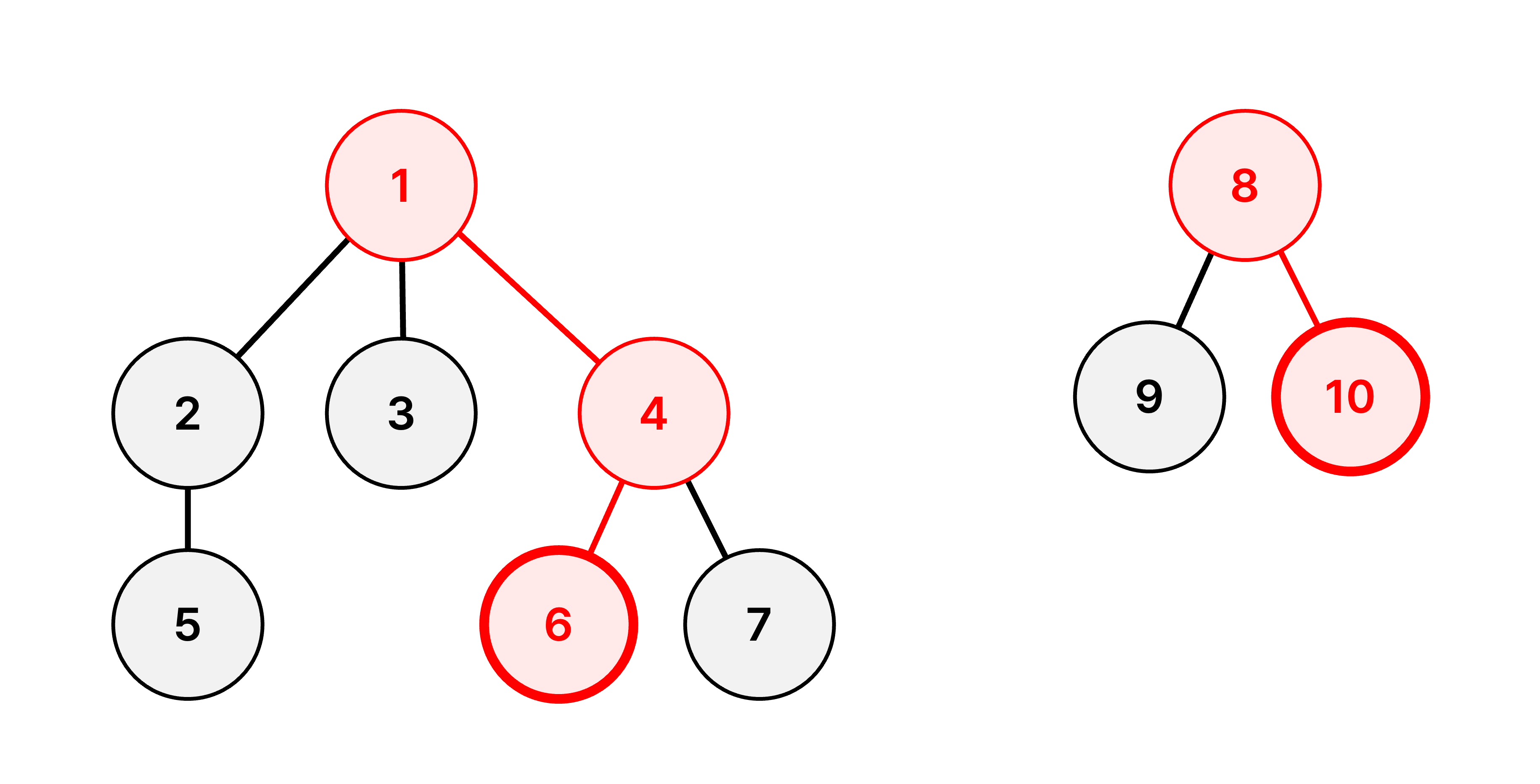
There are two possible ways to merge the trees:
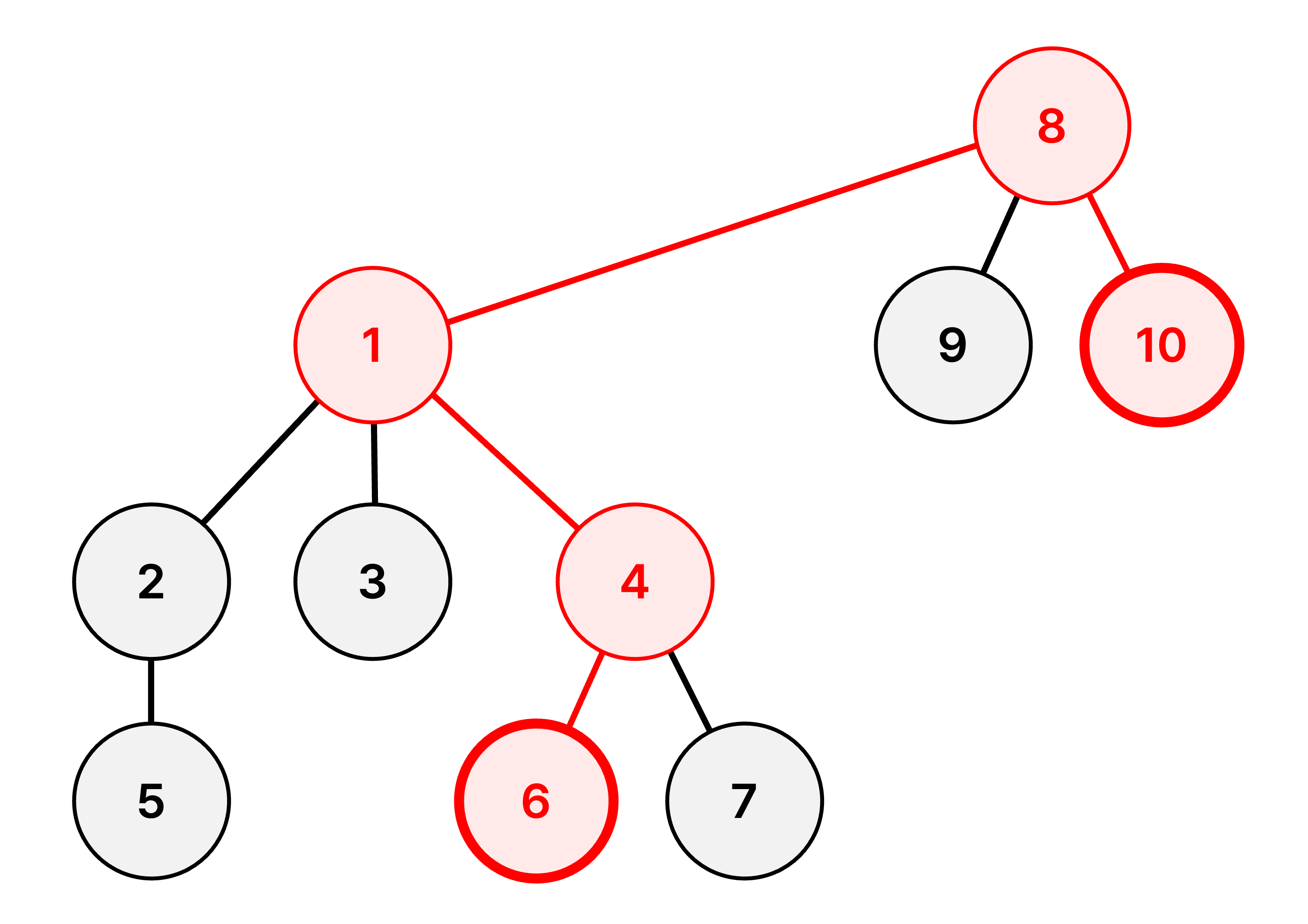
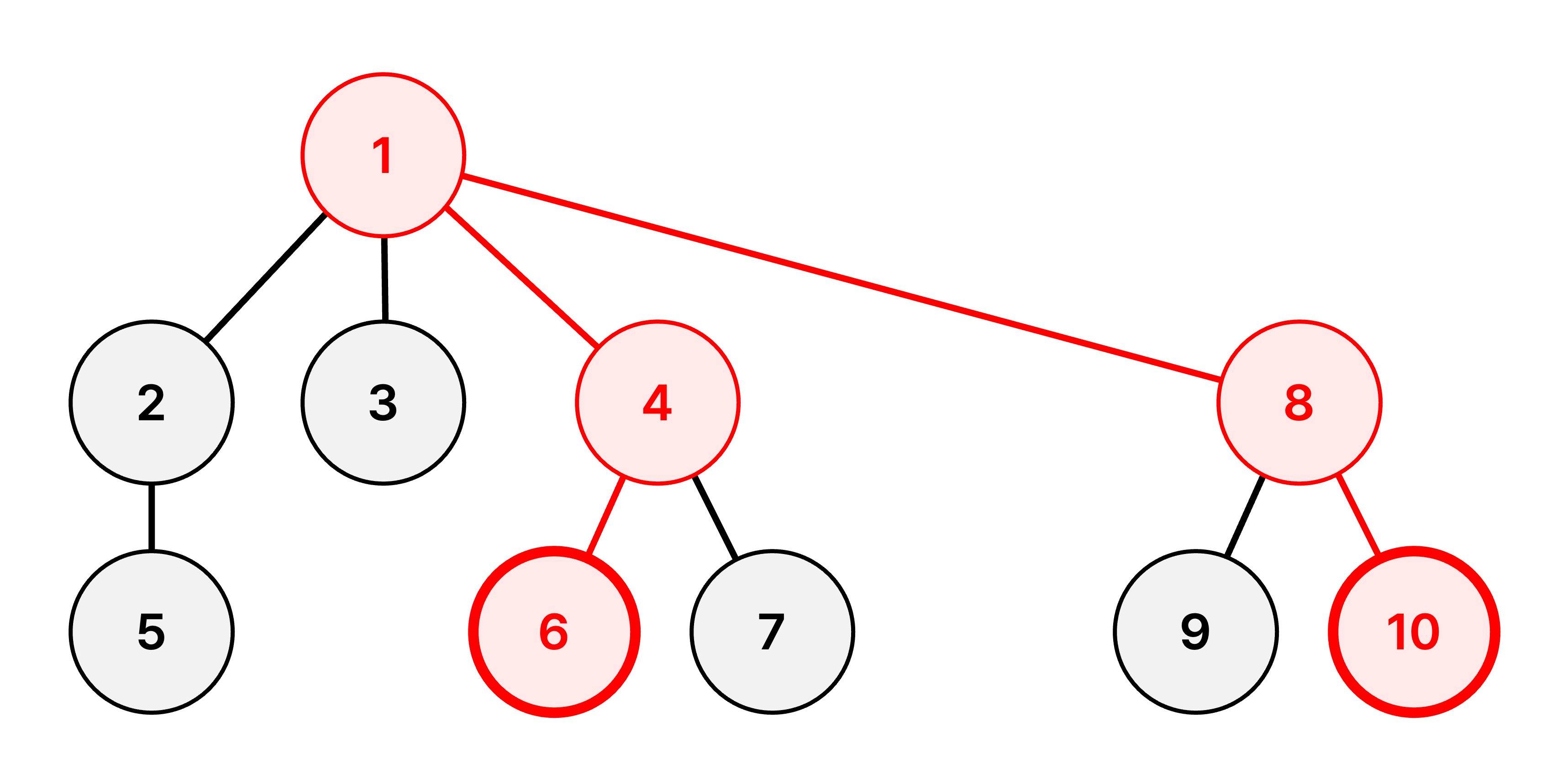
The second method is more optimal for future queries because it minimizes the height of the tree.
By using this strategy, the maximum tree height is guaranteed to be \log_2(N)+1 , and the time complexity of Union/Find operations becomes O(\log_2(N)) .
Path Compression
During the Find operation, the parent of each node in the path is updated to point directly to the root node, flattening the tree structure and reducing the depth for future queries.
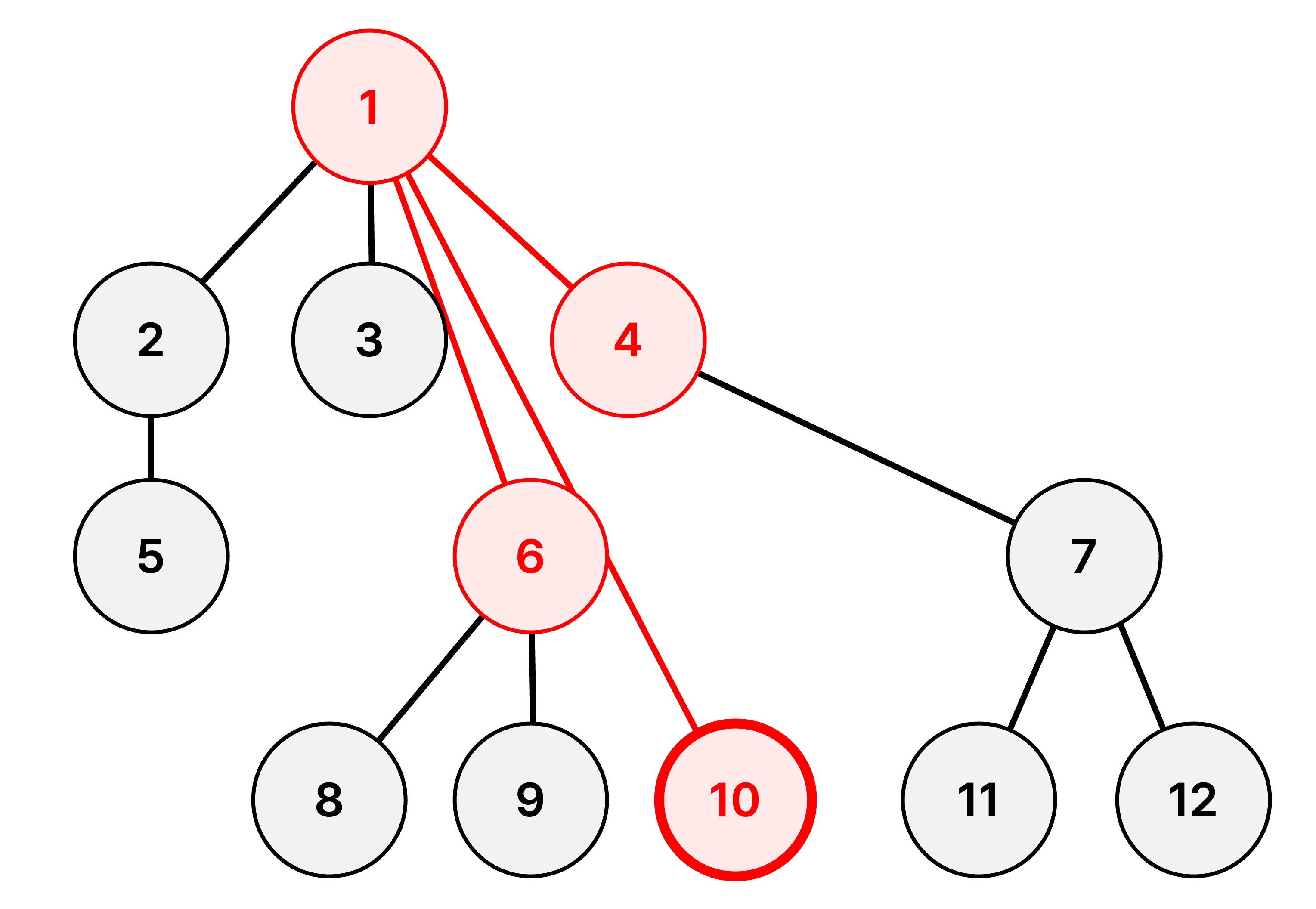
For example, consider the following tree before performing Find on vertex 10:
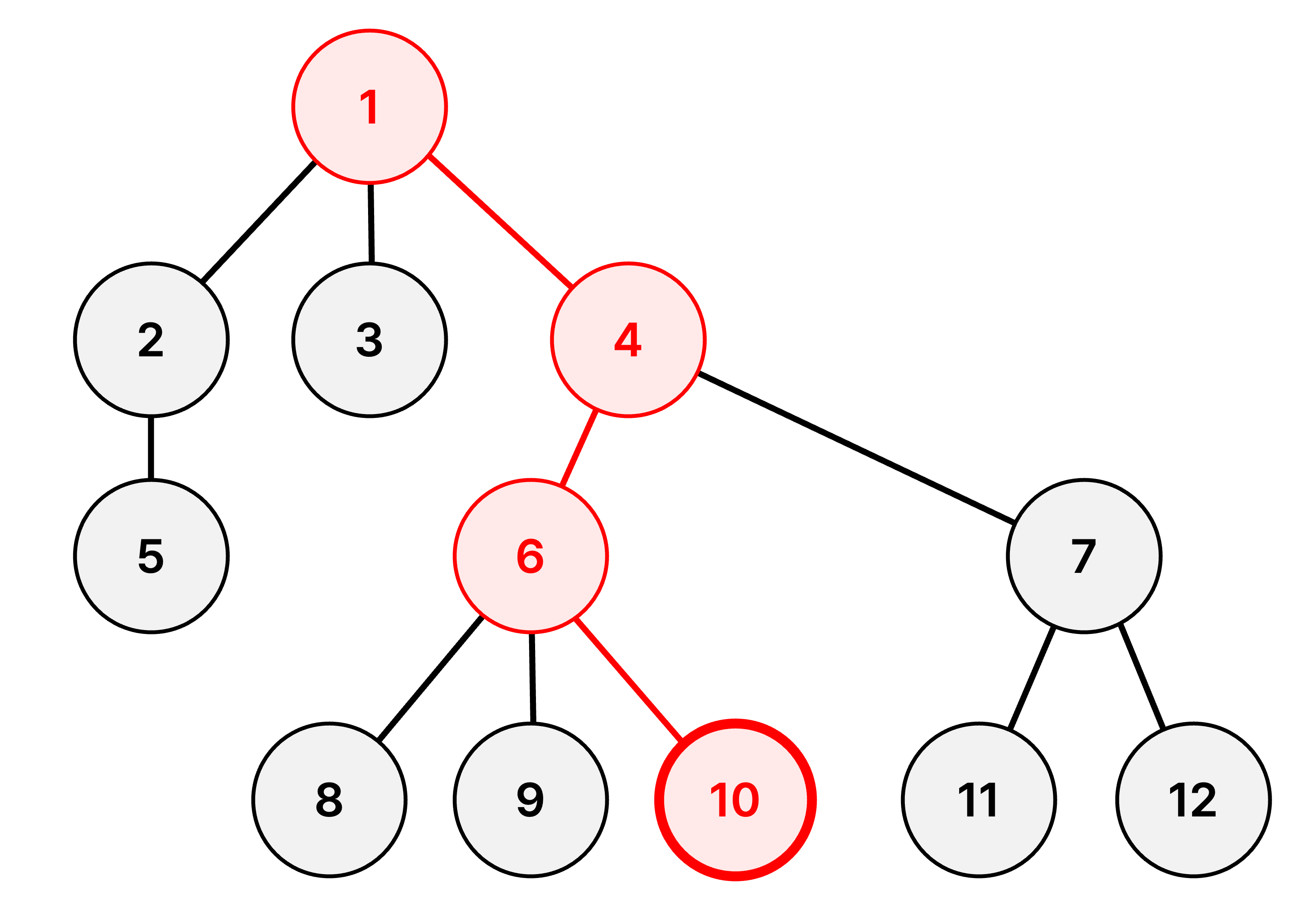
The Find operation determines that the root node is vertex 1. After applying Path Compression, all nodes in the path (4, 6, and 10) directly point to the root node:
After compression:
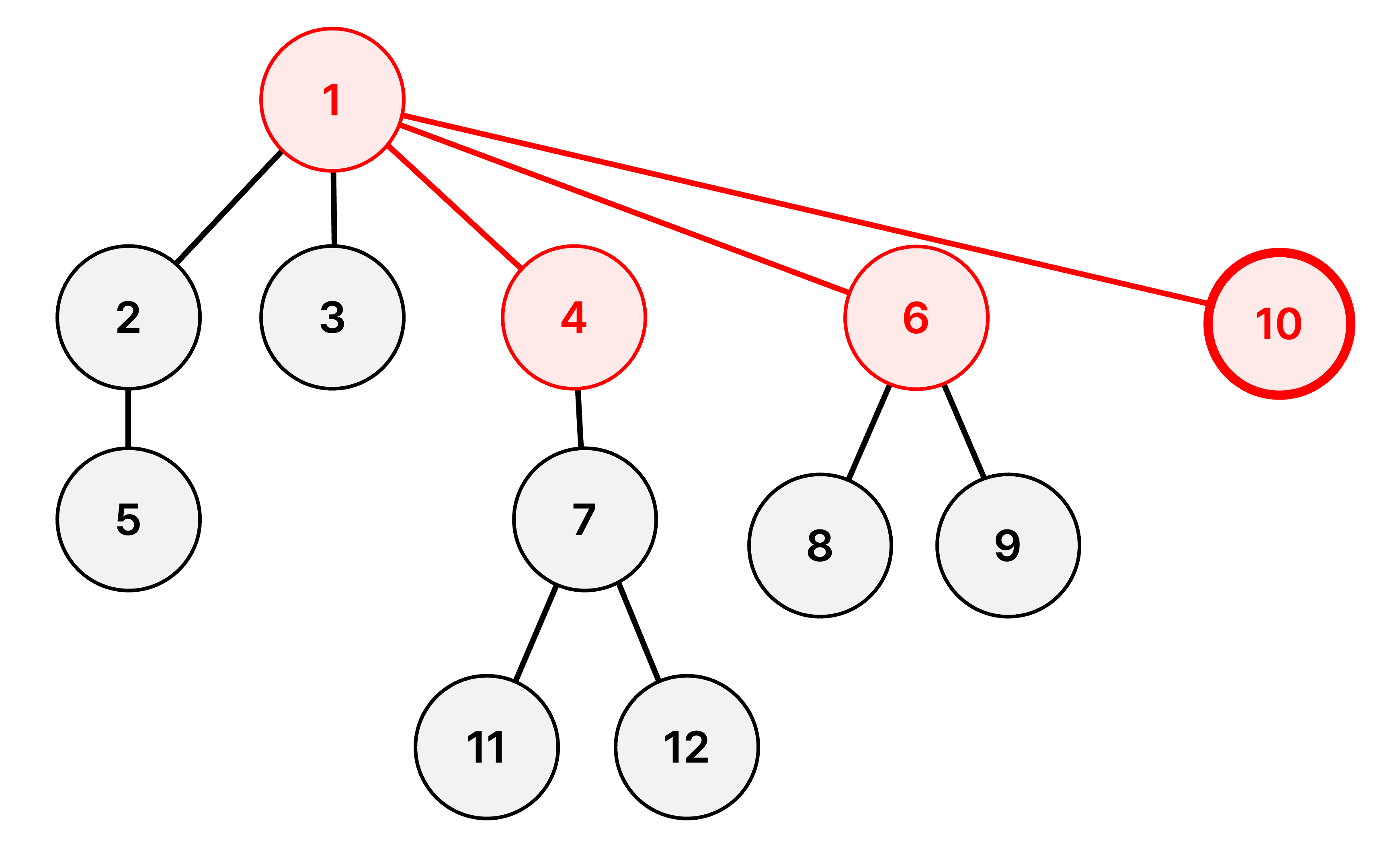
By flattening the tree, the depth of recursive calls during future Find queries is reduced.
Constraints
nis the number of vertices (1 ≤n≤ 100,000).- Each vertex has a unique ID from 1 to
n. queriescontains up to 100,000 queries, each in one of the following formats:- [-1, x, y]: Merge vertices
xandy. - [-2, x, y]: Return
trueifxandyare in the same set; otherwise, returnfalse.
- [-1, x, y]: Merge vertices
x, y are distinct natural numbers between 1 and n.
Test Cases
| Test Case Number | n | queries | return |
|---|---|---|---|
| 1 | 5 | [[-1,3,5],[-1,4,1],[-2,4,3],[-2,4,1]] | [false,true] |
| 2 | 9 | [[-1,2,7],[-2,2,7],[-2,2,7],[-1,6,9],[-1,6,8],[-1,9,2],[-1,2,3],[-2,3,8],[-1,9,7],[-2,6,9]] | [true,true,true,true] |
| 3 | 5 | [[-1,3,5],[-2,5,1],[-1,1,5],[-1,3,5],[-1,2,5],[-1,1,2],[-2,5,4]] | [false,false] |
Explanation for Test Case 1
- Query [-1,3,5]: {1}, {2}, {3,5}, {4}
- Query [-1,4,1]: {1,4}, {2}, {3,5}
- Query [-2,3,4]: false
- Query [-2,4,1]: true
Explanation for Test Case 2
- Query [-1,2,7]: {1}, {2,7}, {3}, {4}, {5}, {6}, {8}, {9}
- Query [-2,2,7]: true
- Query [-2,2,7]: true
- Query [-1,6,9]: {1}, {2,7}, {3}, {4}, {5}, {6,9}, {8}
- Query [-1,6,8]: {1}, {2,7}, {3}, {4}, {5}, {6,8,9}
Explanation for Test Case 3
- Query [-1,3,5]: {1}, {2}, {3,5}, {4}
- Query [-2,5,1]: false
- Query [-1,1,5]: {1,3,5}, {2}, {4}
- Query [-1,3,5]: {1,3,5}, {2}, {4}
- Query [-1,2,5]: {1,2,3,5}, {4}
- Query [-1,1,2]: {1,2,3,5}, {4}