Problem
Given the number of vertices n and query information queries, write a solution function to process queries based on their types and return the results.
There are two types of queries:
- [-1, x, y] - Union Query:
Merge verticesxandyinto the same set. - [-2, x, y] - Find Query:
Returntrueif verticesxandybelong to the same set; otherwise, returnfalse.
x and y are distinct natural numbers between 1 and n.
Concept Explanation
The Union-Find Algorithm is a method to efficiently represent and manipulate disjoint sets. It supports the following two operations:
- Union: Merge two disjoint sets into one.
- Find: Determine which set an element belongs to.
Disjoint sets are typically represented using trees with root nodes. For example:
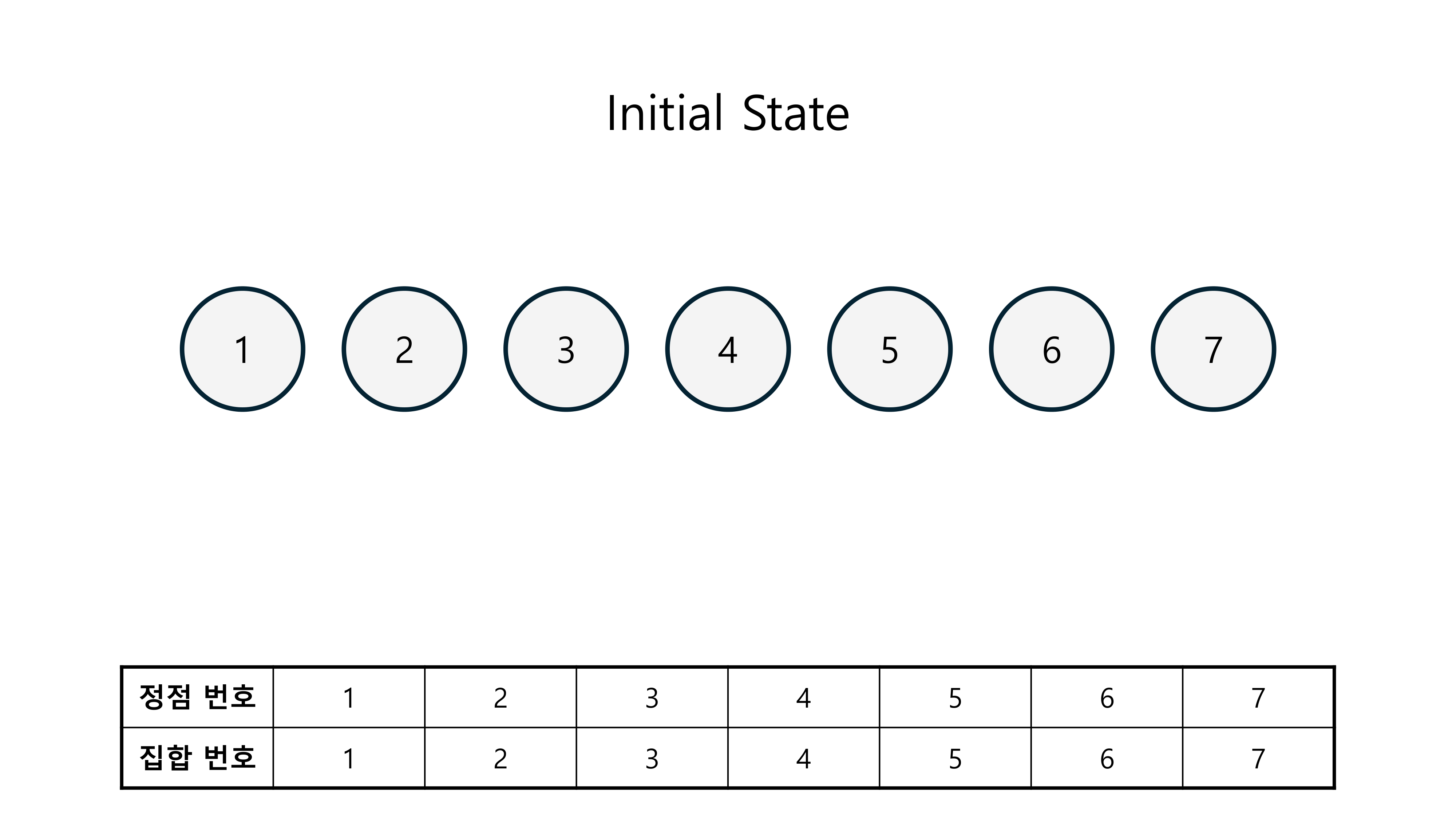
Initially, each vertex (1 to 7) is in its own set, where the set number matches the vertex number:
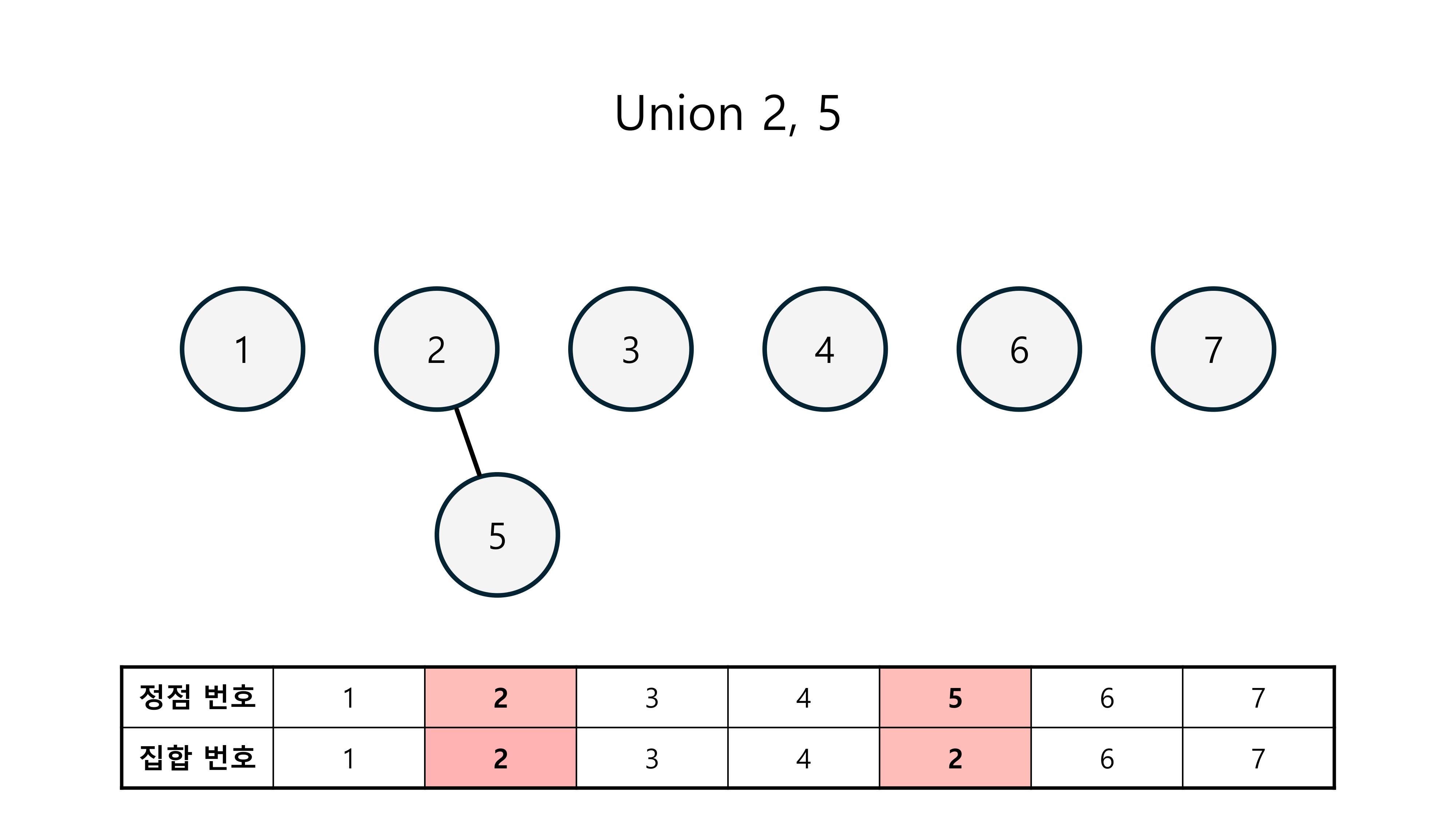
Performing Union 2, 5 merges the sets containing vertices 2 and 5. The set number is updated to the lower number:
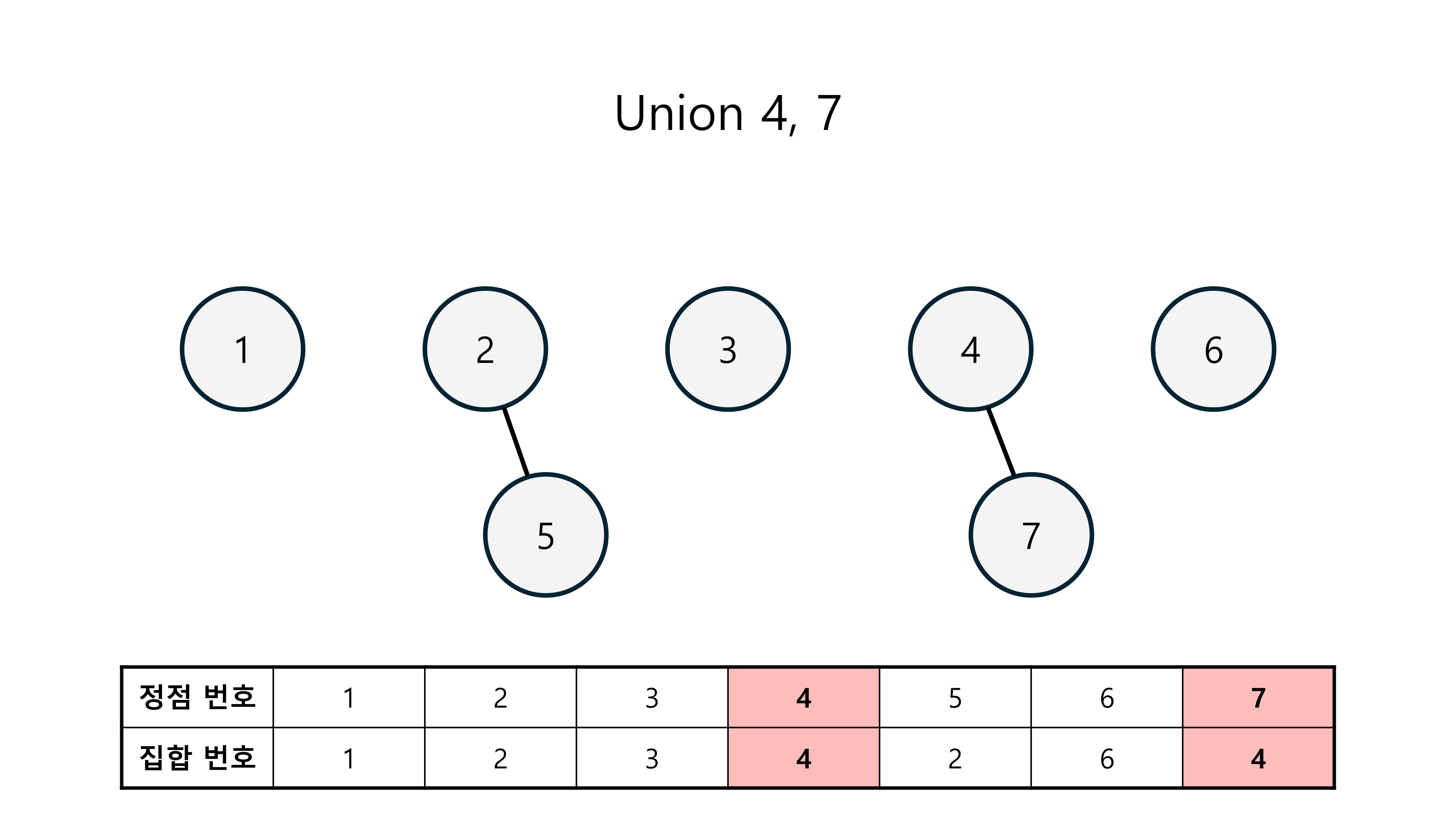
Performing Union 4, 7 similarly updates the set numbers:
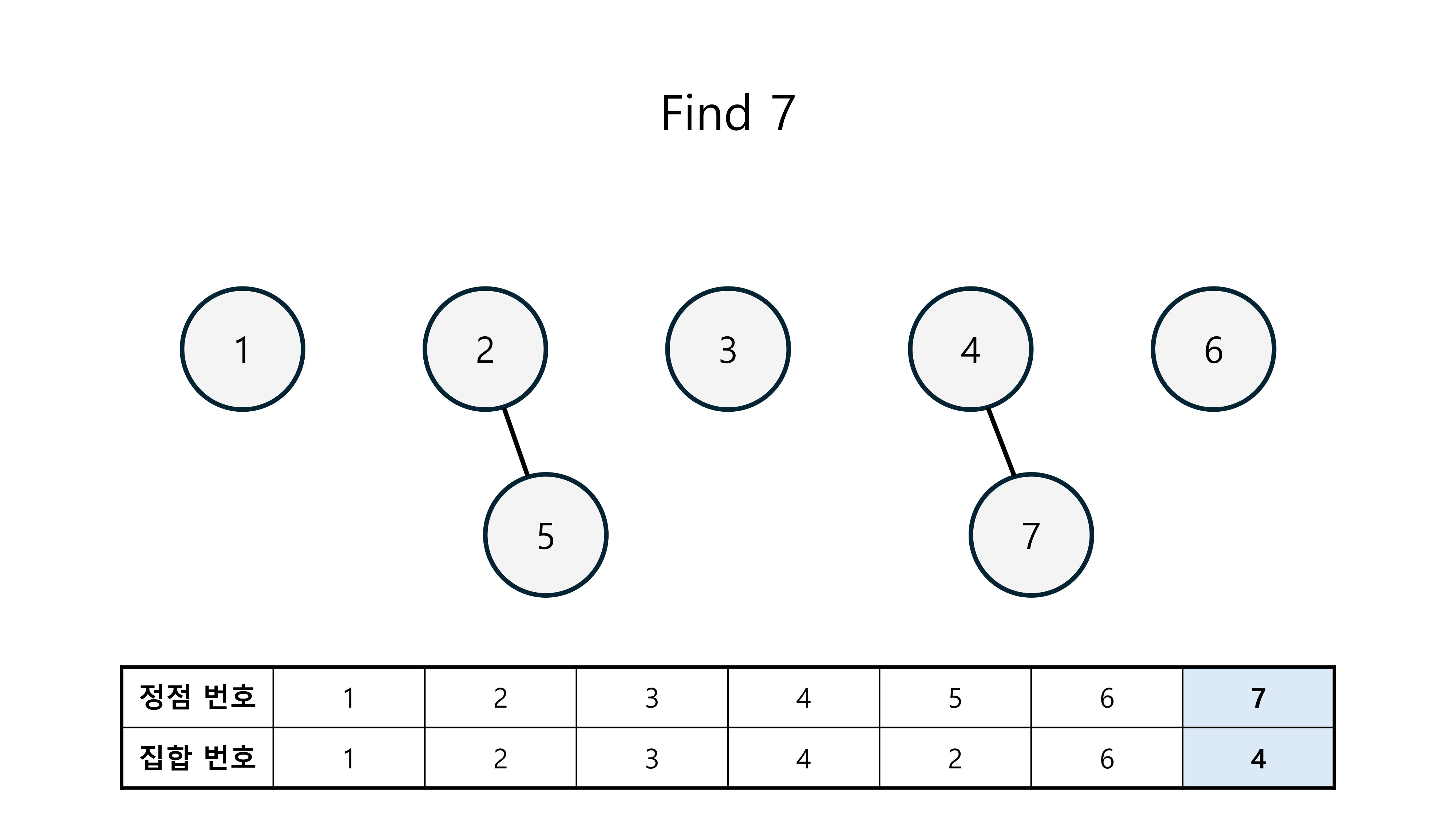
The Find operation determines the set number. For example, Find 7 returns 4:
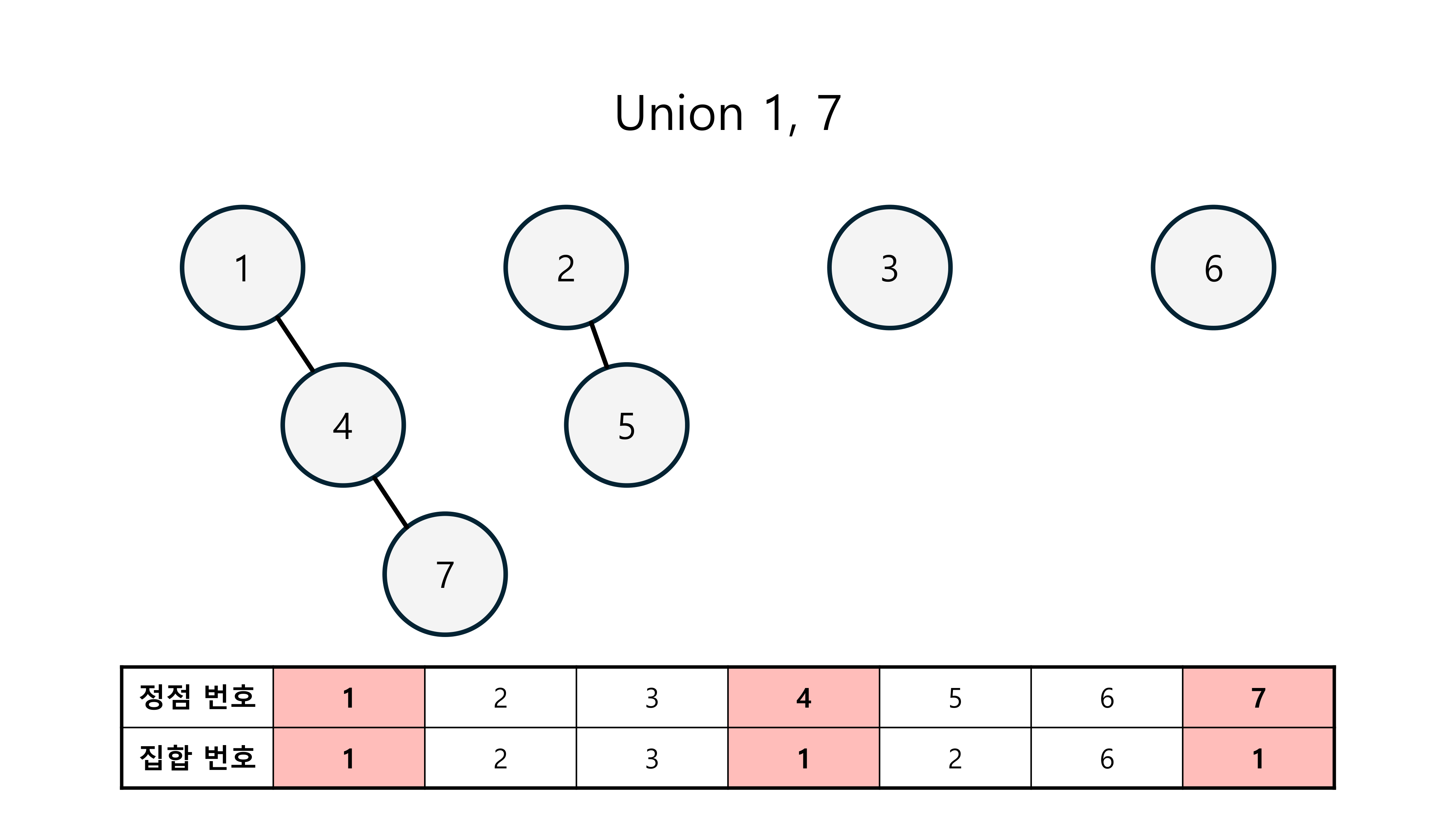
Performing Union 1, 7 merges the sets containing 1 and 7, resulting in the following structure:
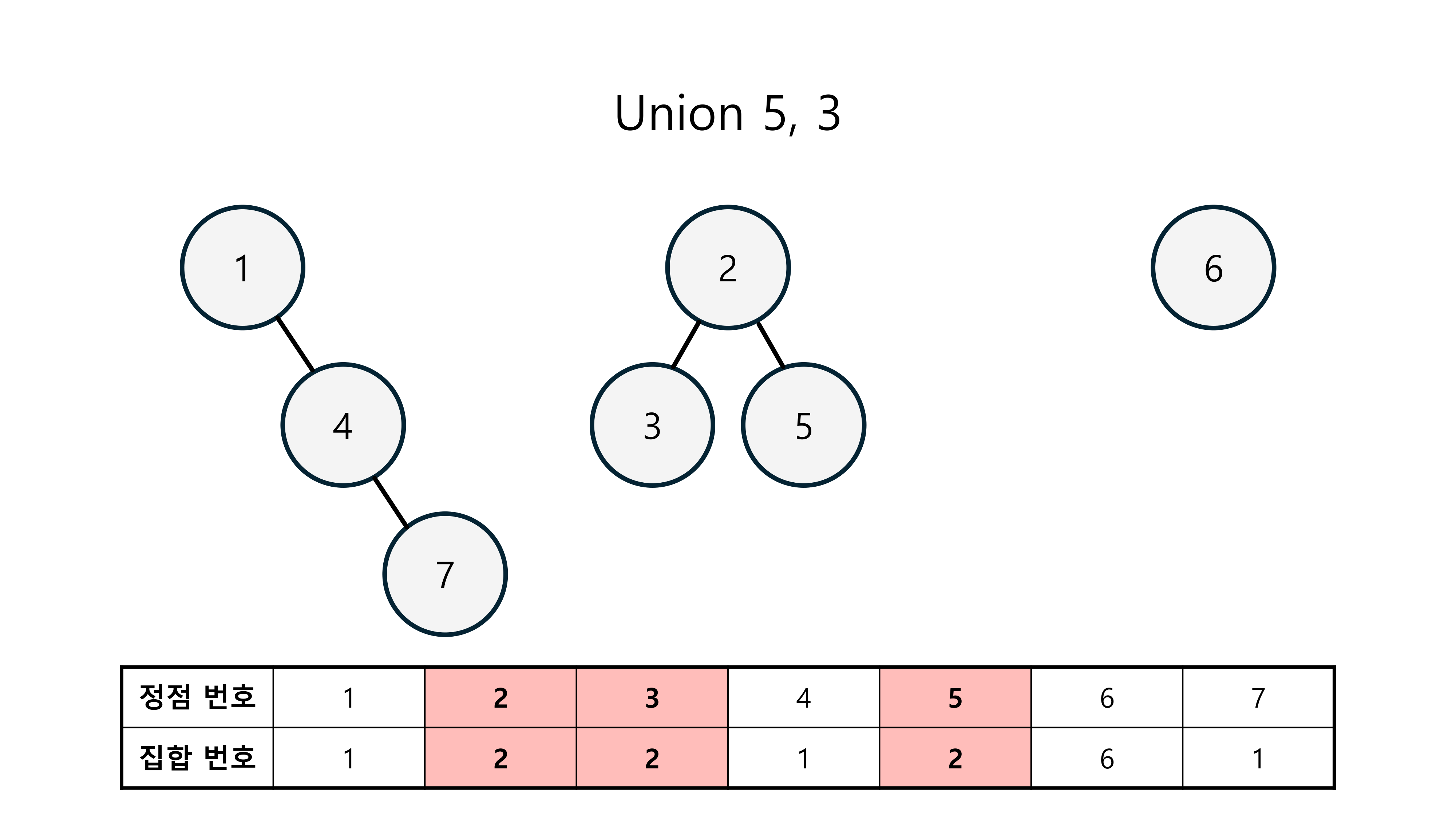
Similarly, performing Union 5, 3 updates the set numbers:
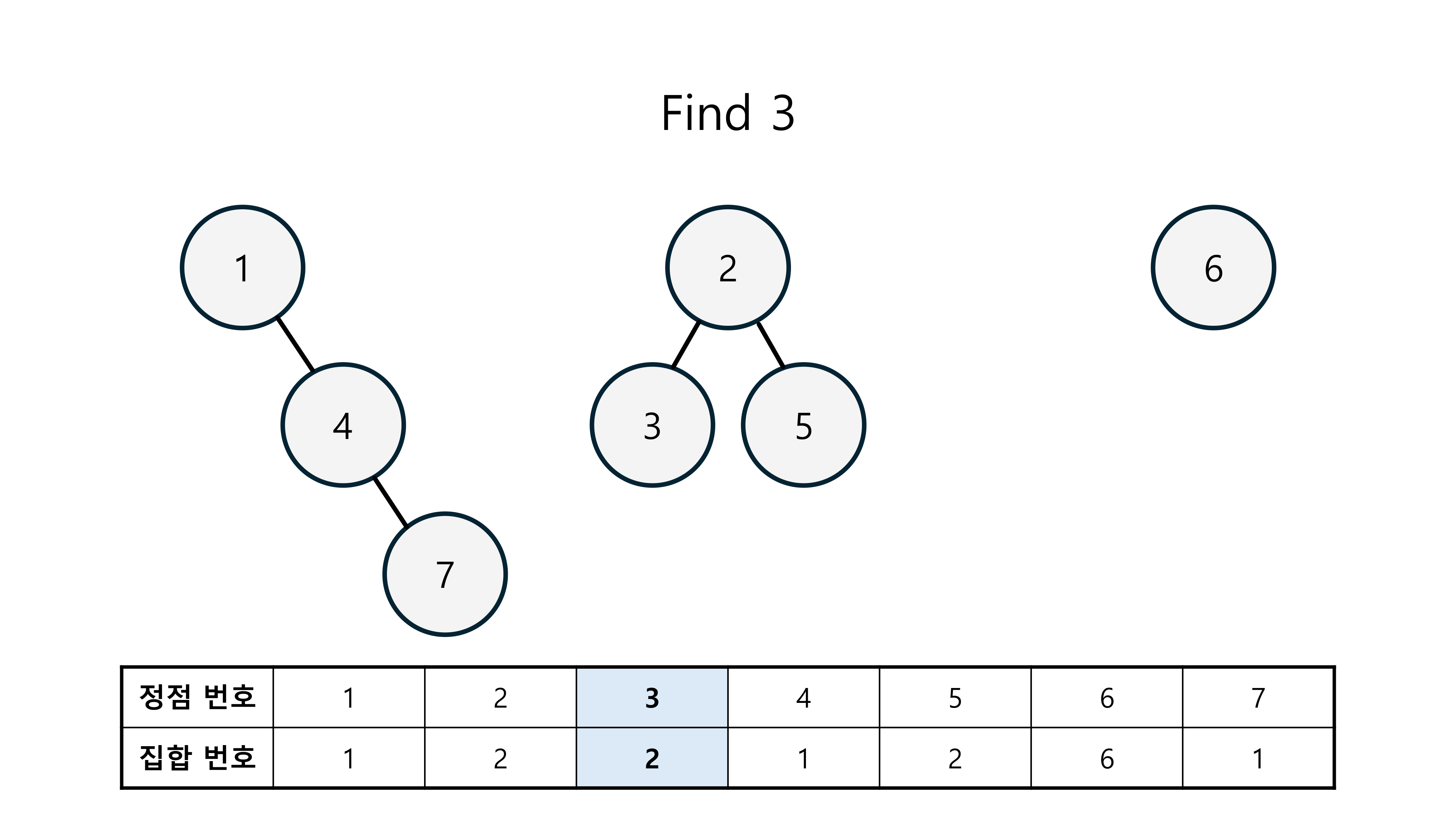
After these operations, vertex 3 is in the set represented by 2:
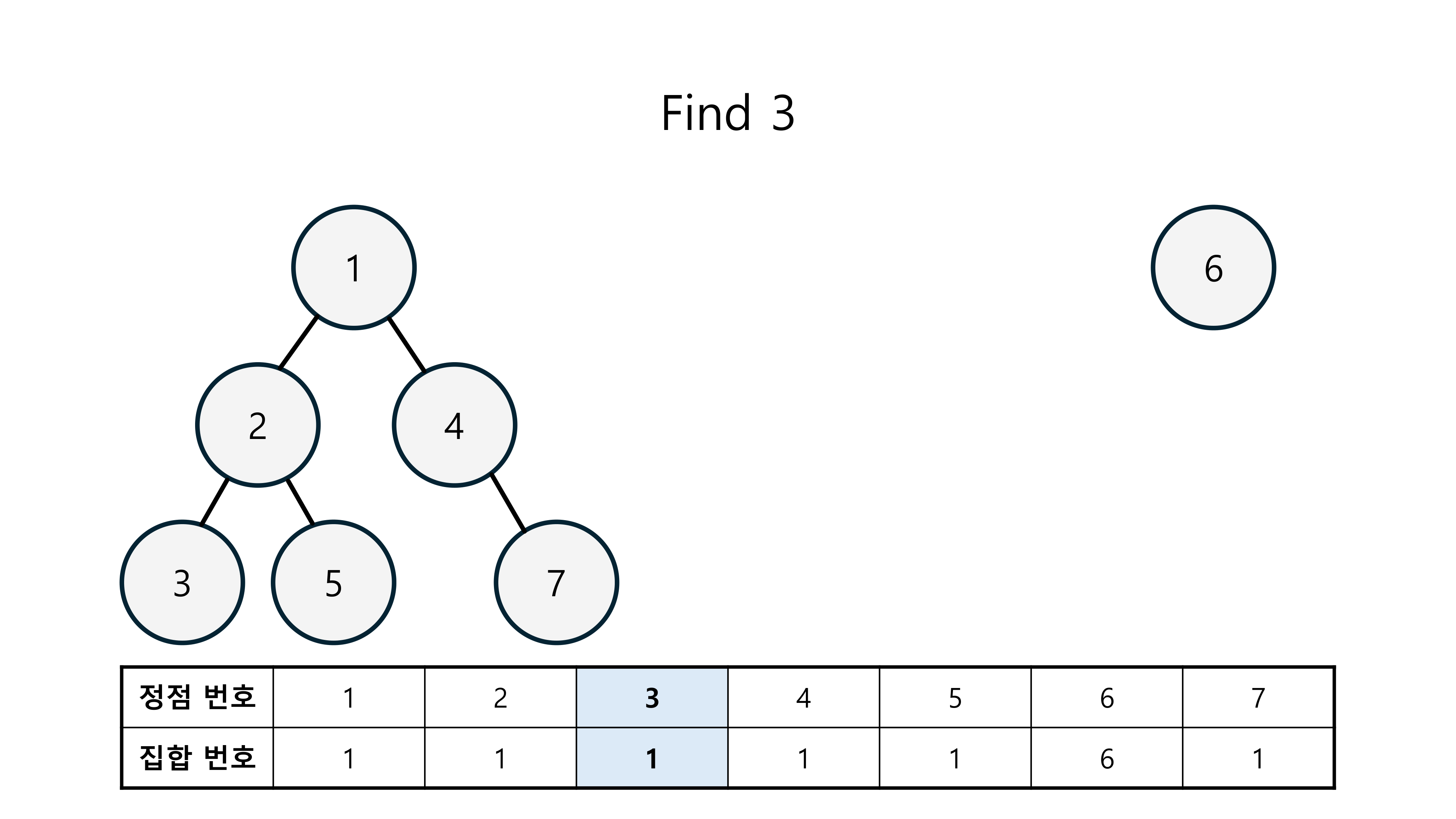
Finally, performing Union 5, 7 merges sets containing 5 and 7 into the set represented by 1:
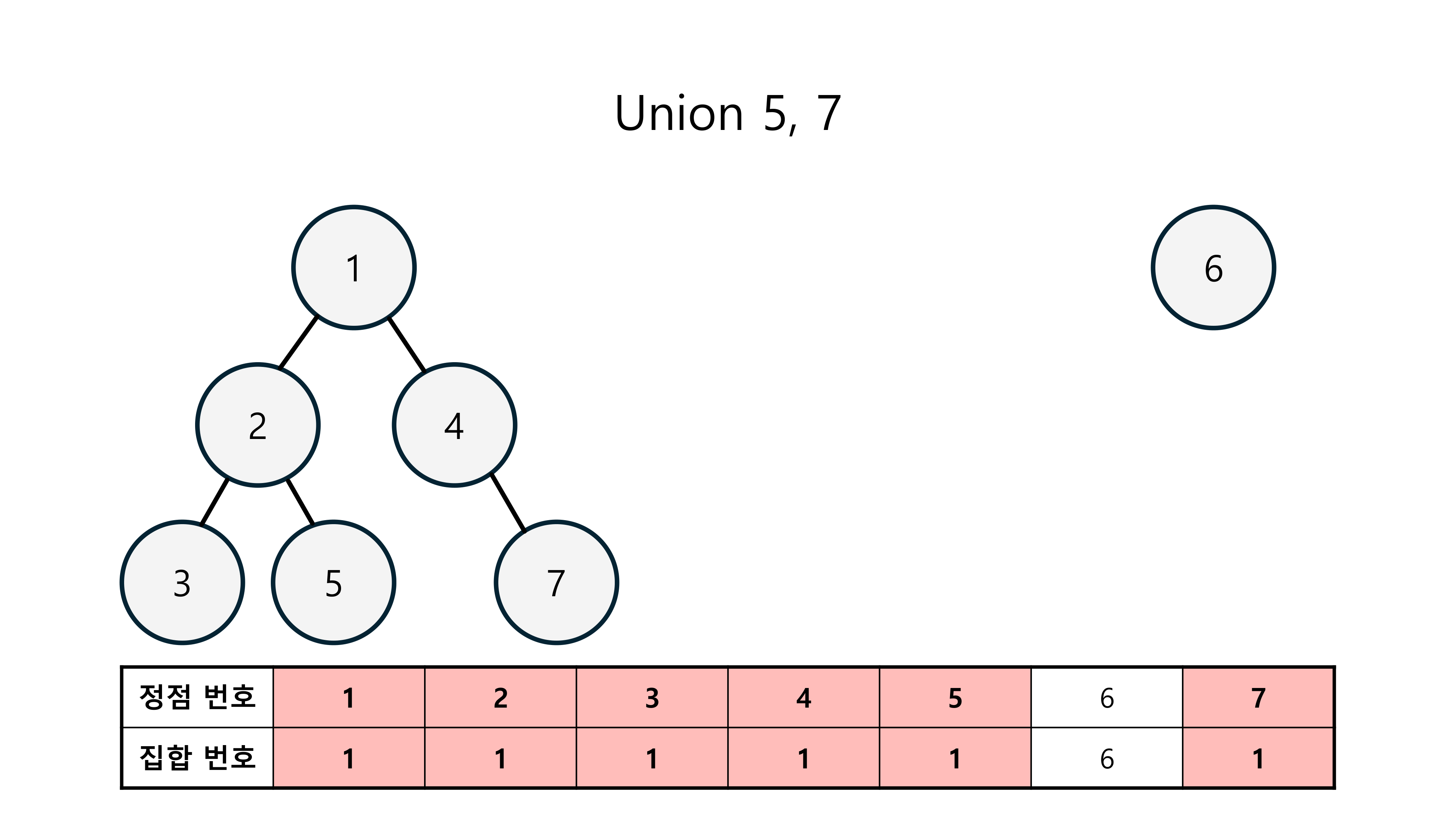
Afterward, vertex 3 is confirmed to be in the set represented by 1:
Union-Find optimizations such as Union By Rank and Path Compression reduce query time complexity to nearly constant time. Without optimization, each query requires O(N) time, but with optimizations, the time complexity becomes O(\alpha(N)), where \alpha(N) is the inverse Ackermann function.
Constraints
nis the number of vertices (1 ≤n≤ 10,000).queriescontains up to 10,000 elements:- [-1, x, y]: Merge vertices
xandy. - [-2, x, y]: Check if
xandybelong to the same set and returntrueorfalse.
- [-1, x, y]: Merge vertices
x,yare distinct natural numbers between 1 andn.
Test Cases
| Test Case Number | n | queries | return |
|---|---|---|---|
| 1 | 5 | [[-1,3,5],[-1,4,1],[-2,3,4],[-2,4,1]] | [false, true] |
| 2 | 9 | [[-1,2,7],[-2,2,7],[-2,2,7],[-1,6,9],[-1,6,8]] | [true, true, true] |
| 3 | 5 | [[-1,3,5],[-2,5,1],[-1,1,5],[-1,3,5],[-1,2,5]] | [false, false] |
Explanation for Test Case 1
- Query [-1,3,5]: {1}, {2}, {3,5}, {4}
- Query [-1,4,1]: {1,4}, {2}, {3,5}
- Query [-2,3,4]: false
- Query [-2,4,1]: true
Explanation for Test Case 2
- Query [-1,2,7]: {1}, {2,7}, {3}, {4}, {5}, {6}, {8}, {9}
- Query [-2,2,7]: true
- Query [-1,6,9]: {1}, {2,7}, {3}, {4}, {5}, {6,9}, {8}
- Query [-1,6,8]: {1}, {2,7}, {3}, {4}, {5}, {6,8,9}
Explanation for Test Case 3
- Query [-1,3,5]: {1}, {2}, {3,5}, {4}
- Query [-2,5,1]: false
- Query [-1,1,5]: {1,3,5}, {2}, {4}
- Query [-1,3,5]: {1,3,5}, {2}, {4}
- Query [-1,2,5]: {1,2,3,5}, {4}