Problem
You are given the number of vertices n and bidirectional edge information edges as input parameters. Write a function solution that returns the total number of vertices that can be reached starting from vertex 1, including vertex 1 itself.
For example, consider a graph with 6 vertices and 5 edges, as shown below:
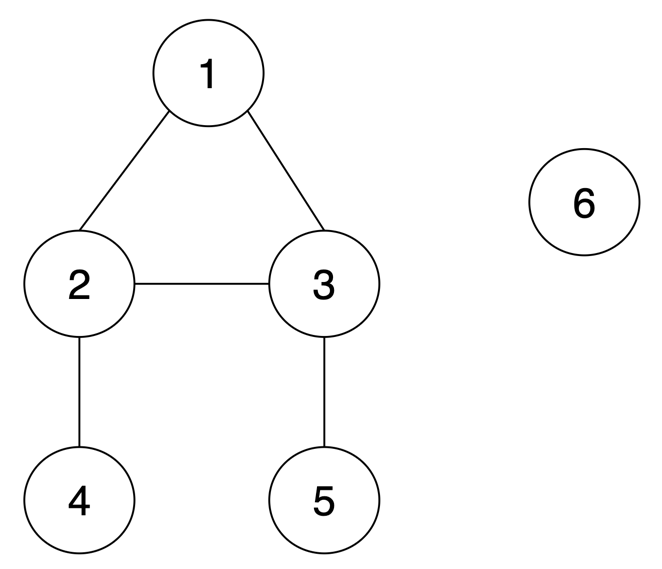
Starting from vertex 1, you can reach vertices 2, 3, 4, and 5, including vertex 1, so the function should return 5.
Constraints
- The number of vertices
nis a natural number between 2 and 10,000 inclusive. - The bidirectional edge information
edgesis represented as a list of pairs(x, y), where:- Each element in
edgesrepresents an edge between verticesxandy. - The list
edgescan contain up to 1,000,000 edges. - Both
xandyare natural numbers between 1 andninclusive.
- Each element in
Test Case
| Test Case Number | n | edges | return |
|---|---|---|---|
| 1 | 6 | [[1,2],[1,3],[2,3],[2,4],[3,5]] | 5 |
| 2 | 10 | [[1,2],[1,4],[1,6],[2,3],[3,4],[3,7],[4,5],[5,6],[5,7],[5,8],[9,10]] | 8 |
| 3 | 2 | [[1,2]] | 2 |
Explanation for Test Case 1
- Starting from vertex 1, you can reach vertices {1, 2, 3, 4, 5}.
Explanation for Test Case 2
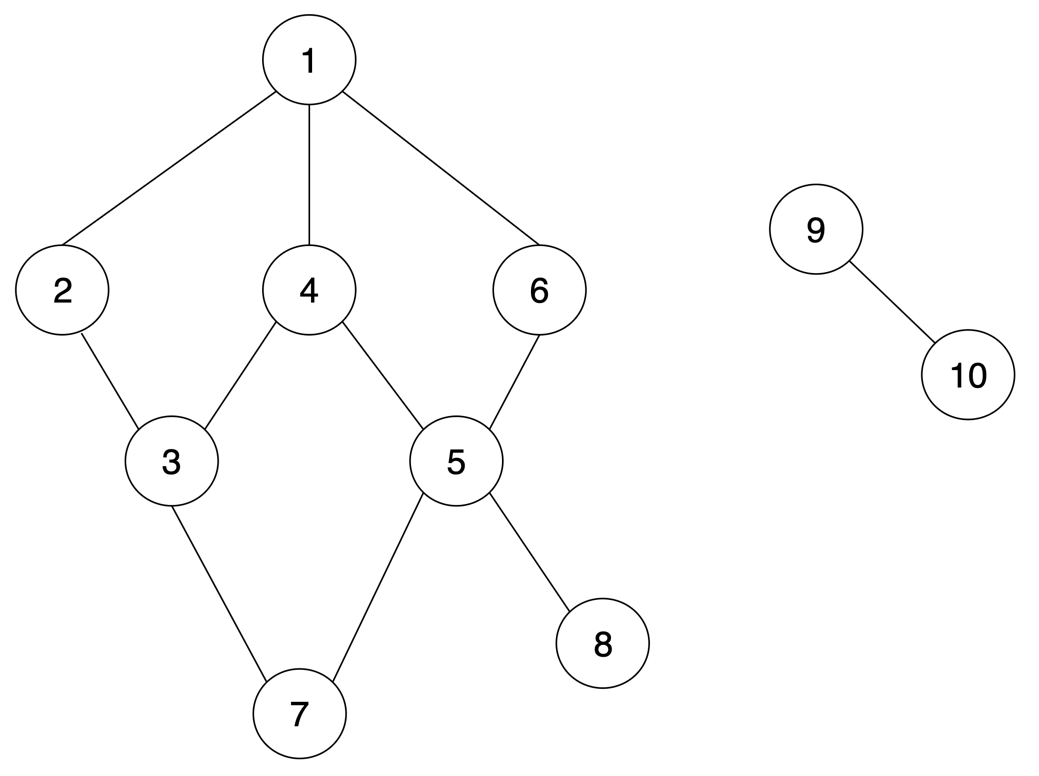
- Starting from vertex 1, you can reach vertices {1, 2, 3, 4, 5, 6, 7, 8}.
Explanation for Test Case 3
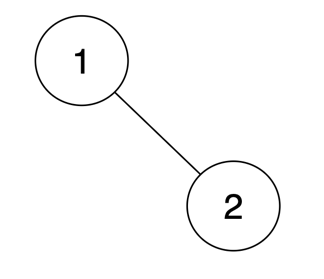
- Starting from vertex 1, you can reach vertices {1, 2}.
Notes
- If an error (runtime error) occurs during test cases 17, 19, or 20 in the
pythondevelopment environment, refer to the following:- Python limits the maximum recursion depth to 1,000.
- Deep recursion calls may result in a
RecursionError, which is a type of runtime error. - To adjust the maximum recursion depth in Python, write code as shown below:
import sys
sys.setrecursionlimit(10**6)

def solution(n, edges):
  return 0